Case 02 — Catawiki
Frontline AI
Overview
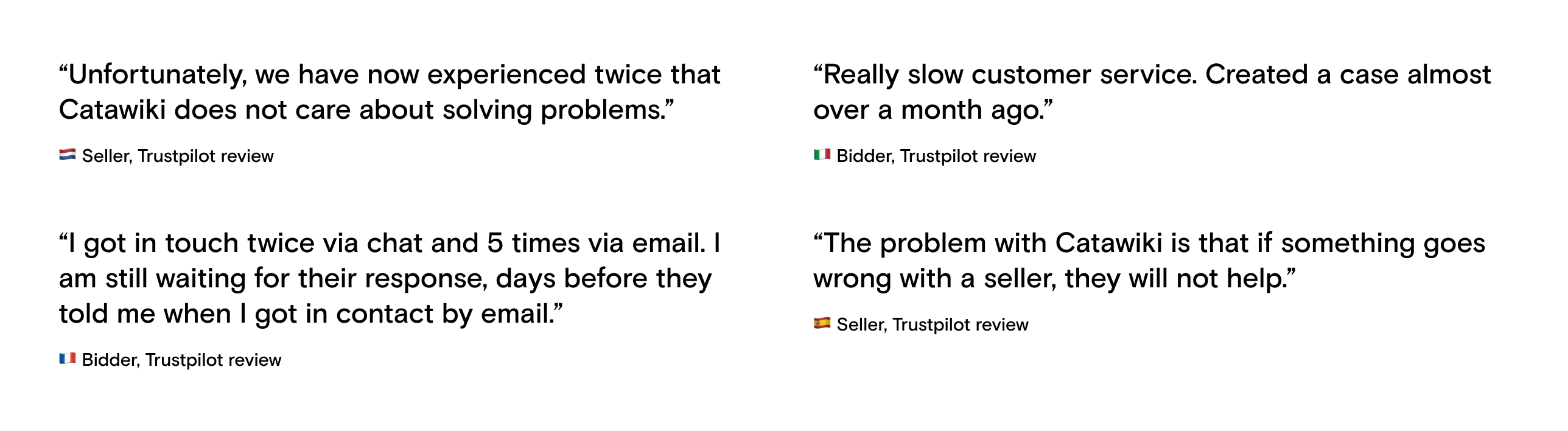
By early 2025, Catawiki had a visible customer satisfaction problem. Buyers and sellers were publicly expressing frustration on Trustpilot: slow responses, unresolved cases, feeling abandoned by a platform they'd trusted. Support hadn't scaled with the business, and retention was suffering for it. The solution Catawiki needed wasn't just more agents; it was a fundamentally different approach to first-contact support.
The answer was Catawiki's first production AI experience: an AI assistant as the first point of contact for all support queries, for both buyers and sellers. It shipped in two phases, each expanding what it could actually do.
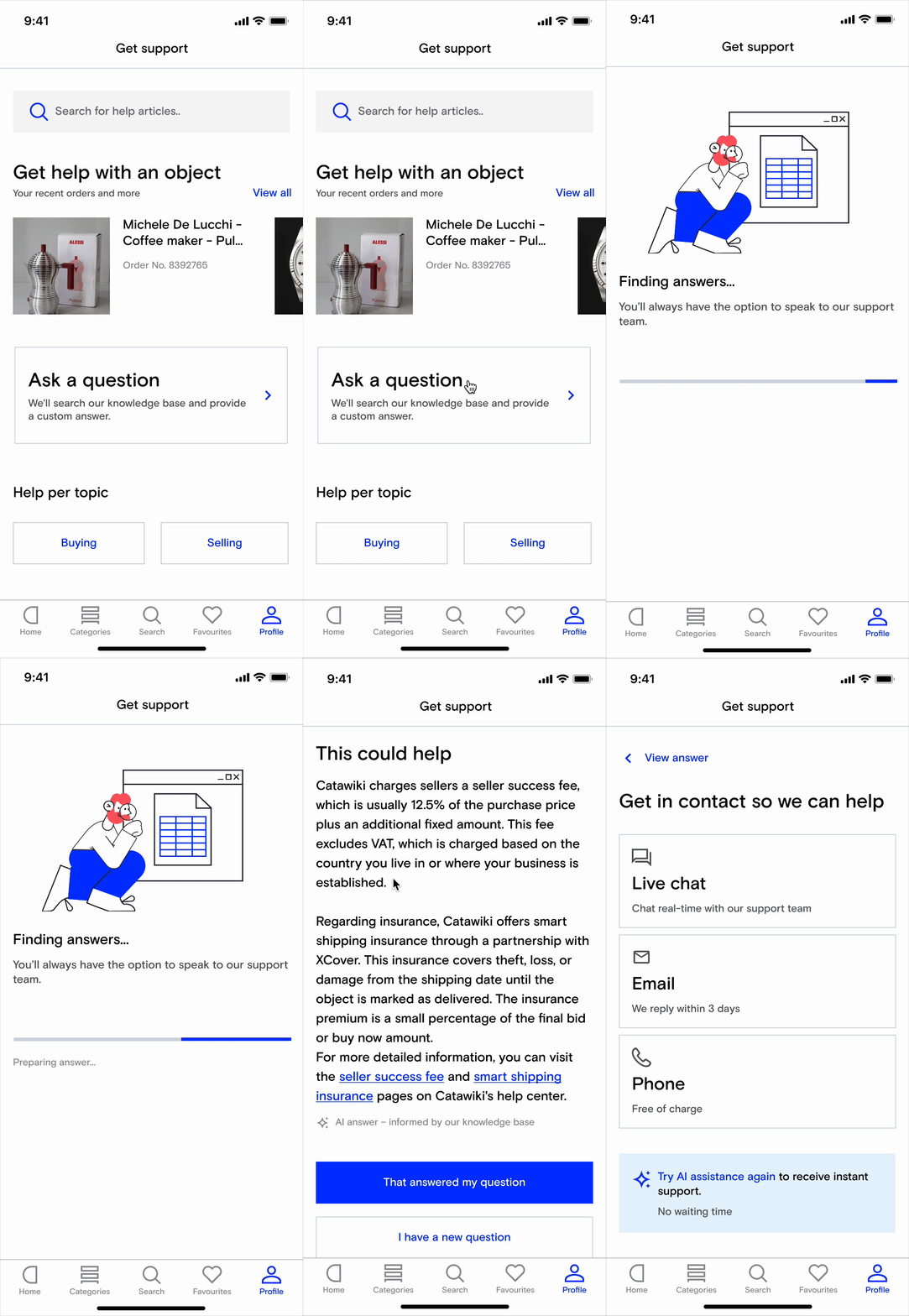
Phase one: ask a question
Phase one, general questions
- Built on OpenAI's models rather than a custom-trained one, grounded in Catawiki's help centre content, decision trees, and internal policies.
- Could answer common questions instantly, work that used to take agents days.
- Required a full audit and rewrite of the underlying content first, since a model grounded in messy content would be just as messy back.
- Classified first, answered second. Every incoming message ran through a contact-reason taxonomy before the assistant drafted anything, so it knew what kind of question it was dealing with.
- Reviewed before it shipped. CS operations checked every response template for tone, accuracy, and legal exposure, like reassurances or promises only a human agent could actually keep.
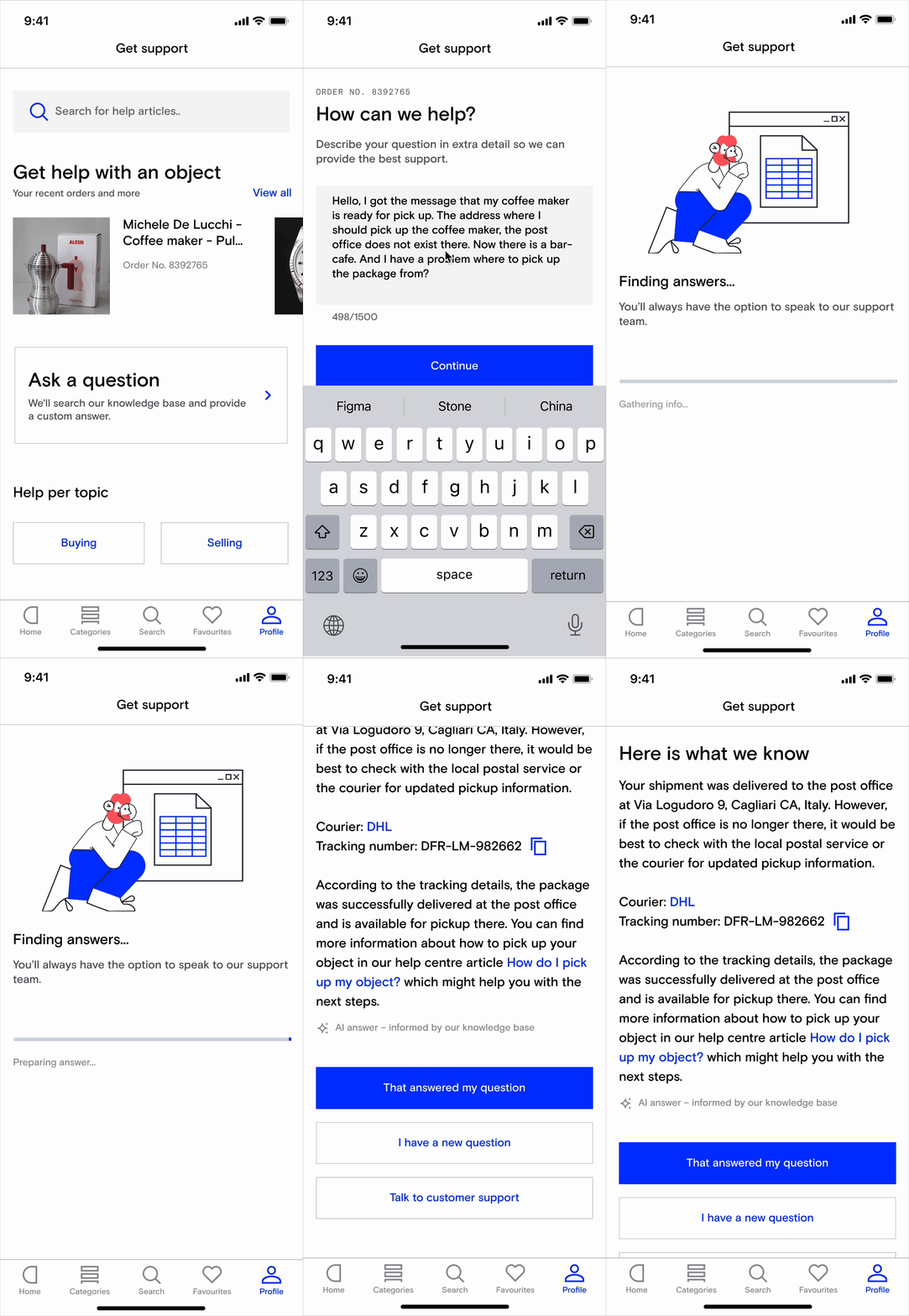
Phase two: select an order
Phase two, transactional questions
- Connected to live systems, including Kustomer and shipping data via Aftership's API, so the AI could look up a specific order or object.
- Could trigger actions directly, like cancellations and refunds.
- Required access to personally identifiable and transactional information for the first time.
- Covered roughly 70% of all incoming contacts.
- Answers adapted to the asker. The same question, like "where's my item," meant something different for a buyer waiting on delivery than a seller waiting on payout.
- Automated templates switched off. Wherever the AI answered directly, the old canned Kustomer templates were disabled, so users didn't get two conflicting messages.
The project was one of Catawiki's highest priorities for 2025 and remains ongoing.
I led this project as Head of Design, coordinating a team of three designers across content, interaction, and design systems, and representing design at the leadership table alongside CS, product, engineering, data science, policy, and trust and safety.
Role & Approach
My role had two dimensions: keeping the customer at the centre of a room full of competing priorities, and helping define what design even means when nobody, including me, had done this kind of work before.
Keeping the user at the centre
- Cross-functional representation: sat at a leadership table with CS, product, engineering, data science, policy, and trust and safety, on a project where engineering and data science carried most of the technical weight. Everyone came in with a different priority; my job was making sure the customer stayed at the centre of decisions that could easily have been made on purely technical or operational logic.
- User advocacy: pushed back when a technically convenient answer would have made the experience worse, not just when it clearly broke something.
- Coordinating the design team: led three designers across content, interaction, and design systems through both build phases.
Designing in unfamiliar territory
- North star vision: helped the team define what great AI-powered support could look like, then stayed on as a thought partner on key decisions as phase one and phase two took shape.
- Reframing the design problem: introduced the wave pool model to reset how the team thought about the work, not fixed flows, but unpredictable, nonlinear conversations where every user takes a different path. Design's job became setting boundaries and managing expectations, not defining a single happy flow.
- Keeping a way out: made sure users could always reach a human agent, a constraint that was easy to lose sight of the more the assistant took on.
Alex Klein, founder of Team Human, described this shift well: traditional design is like building a waterslide, minimising friction and keeping everyone on one fixed path, the happy flow. AI-driven experiences are more like a wave pool, no clear path, and every user finds their own way through.
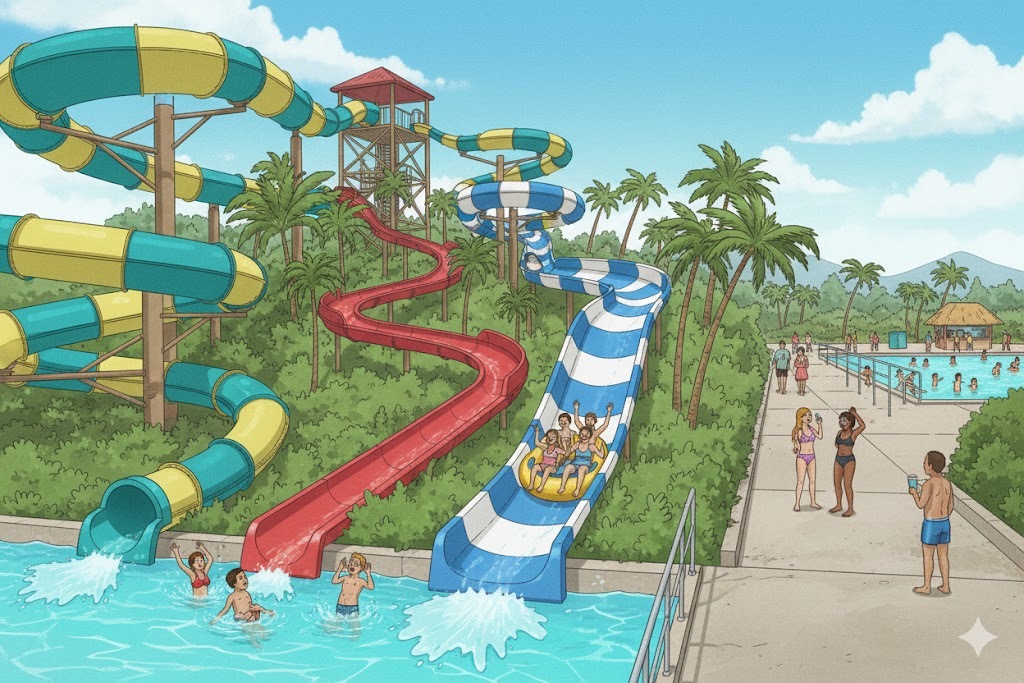
Waterslides: one fixed path, the happy flow
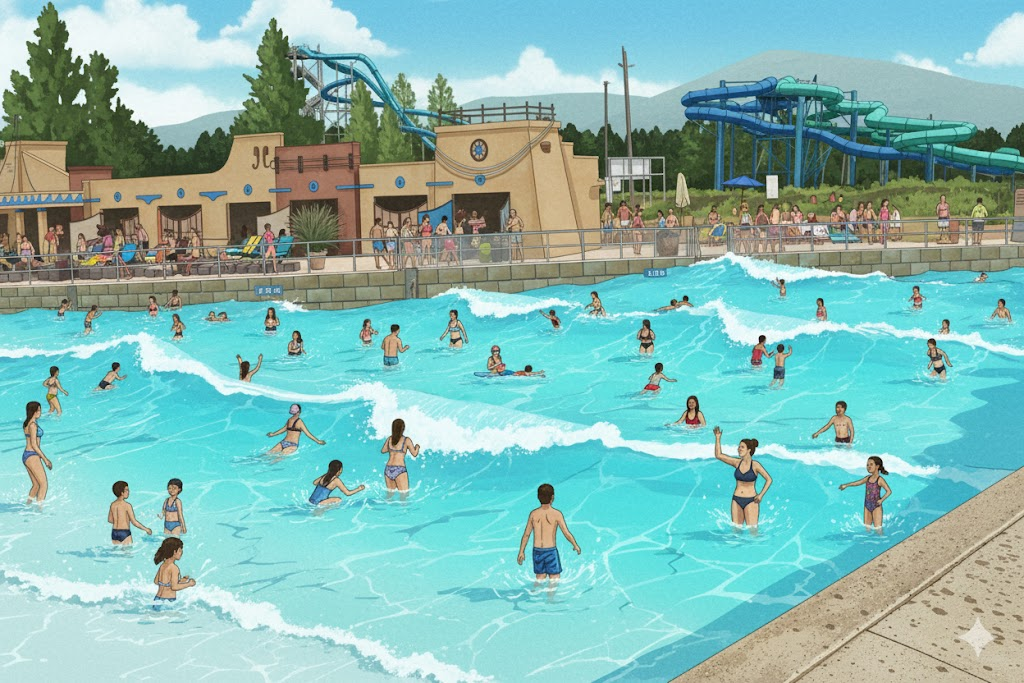
Wave pools: no fixed path
Success was measured primarily by contact deflection and human-handled contact volume, with customer satisfaction as the check that automation wasn't coming at the user's expense.
Key Decisions
This was a technology-led project more than a design-led one. What the model could reliably do, and what engineering could safely connect it to, set the boundaries most decisions had to work within. Design's job was to make sure the user didn't feel those boundaries as friction, and to push back when a technically convenient answer would have made the experience worse.
1. Standardizing responses to control quality, not just consistency.
When a model update started adding headers to responses and broke the tone of voice completely, having standardized response templates meant we could catch and correct it quickly rather than letting the design quietly unravel. The real value of standardization wasn't uniformity for its own sake: it was reducing our dependence on the behaviour of the underlying model.
2. Building QA as an ongoing practice, not a launch gate.
With a fixed product, you test the happy flow and ship. With AI, the model's behaviour shifts with updates, and conversations go in directions you never anticipated. Part of that meant building an automated evaluation harness, benchmarked against a golden dataset, to catch drift before users did. The decision to build prompt refinement and sentiment monitoring into the team's regular rhythm, permanently, was a cultural shift as much as a process one.
3. Rolling out gradually to preserve the ability to course-correct.
A full launch would have scaled problems before we could identify them. Incremental exposure gave us room to observe, learn, and adjust at each stage before going further.
Outcome & Impact
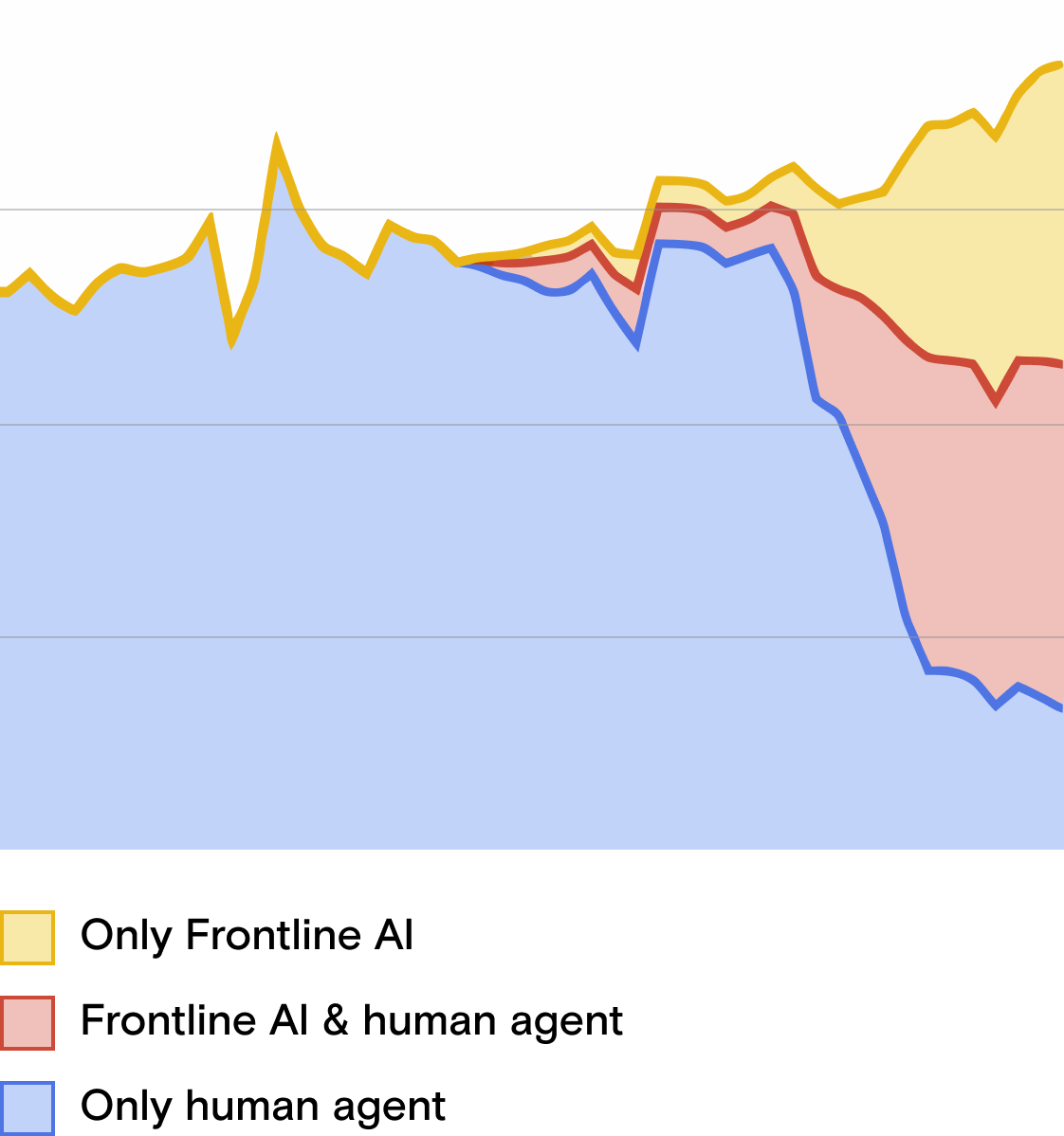
Where incoming contacts stand today
Results and metrics
- Quantitative Outcomes: 44% of questions answered by AI without subsequent contact with a human agent.
- Workload Absorption: Despite overall contact volume growing by ~20%, human-handled contacts dropped by ~15%: the AI absorbed the growth.
- Contact Rate Reduction: Total contact rate reduced by 16% year-on-year in Q3 and 26% in Q4, significantly exceeding the original goal.
- Customer Satisfaction: Improved slightly but consistently across support interactions.
- Headcount Impact: Without the automations built around it, the company estimates it would need double its current CS department to deliver the same quality of support.
Leadership impact
- Company-wide AI template: Frontline AI became Catawiki's first production AI experience, setting the blueprint for subsequent AI features across the company, including ODP object summaries/expert bios and Smartfill's AI-assisted submissions.
- Internal enablement: The team drove broader AI adoption internally, running workshops and monthly AI meetings, and supported other teams in building their own AI-powered tools.
- External thought leadership: The work was presented externally at Bol.com's UX Day, where the approach resonated with designers from other companies facing the same questions.
Reflection
This project changed how I think about what design leadership means in an AI context. On most projects, the design team's job is to define the experience and then hand it over. Here, shipping was the beginning of the work, not the end.
What I'm most proud of is establishing a way of working that the organisation could carry forward. The structured experimentation, the prompt refinement cycles, the content standardisation approach: these weren't just solutions to this project's problems, they became patterns for how Catawiki thinks about AI product work more broadly.
The thing I'd do differently is push for design to be involved earlier in the technical scoping. There were moments where architectural decisions had already been made that constrained the experience in ways that were hard to unpick later.