Case 03 — Catawiki
Object-based submission
Overview
Catawiki's original submission flow asked sellers to choose an auction before describing their object. Which auction is right for a diamond engagement ring? Exclusive Certified Jewellery. Fine Certified Jewellery. Gold Jewellery. Antique & Vintage Jewellery. All plausible, and a new seller had no way to know which one mattered. Most sellers guessed. Neither did the flow, really; it just asked them to pick. When experts corrected the auction choice afterwards, all the structured data the seller had submitted was lost, tied to the auction rather than the object, and had to be reworked by hand. The questions sellers faced were generic, not specific to what they were actually selling. Data quality suffered on both sides of the marketplace.
The new flow flipped the model entirely. Start with the object, not the auction. "What can we help you sell?" became the opening question, followed by cascading, object-specific questions that built structured data tied to the object itself.
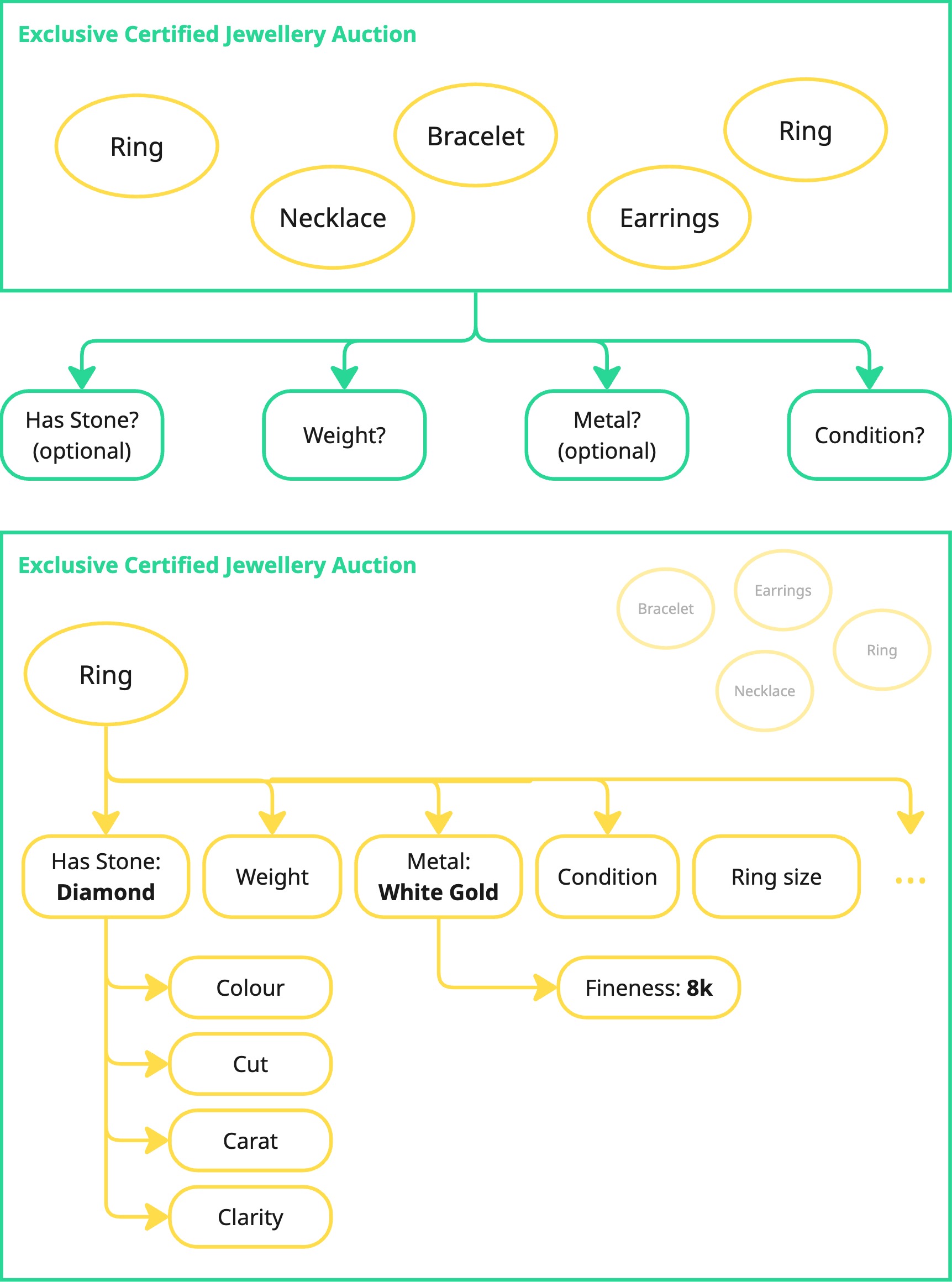
Before, every jewellery auction asked the same four generic questions, Does it have a stone? What's the weight? What metal is it made of? What's the jewellery's condition? A ring and a bracelet got identical prompts, regardless of how different they actually were as objects. After, selecting "Ring" unlocked its specific object details, and depending on their values, more specific questions: if the ring has a stone that is a diamond, then, only then, a cascading set of diamond details (colour, cut, carat, clarity). The object itself decided which questions appeared, not the auction it happened to sit in.
The results:
- Richer, more accurate data collection
- A faster, clearer seller experience
- A more efficient workflow for experts
- Better search, filters, and recommendations for buyers
- Auction flexibility and multi-auction listing, both impossible under the old architecture
That shift from generic, auction-level fields to rich, object-specific ones is the foundation everything else in this case study builds on.
I joined Catawiki in May 2021 as Lead Product Designer, responsible for the seller experience across the board. OBS quickly became the centre of that work, growing from a hands-on design effort into leading three multidisciplinary teams through to full launch in 2023. A year and a half in, I stepped into management, becoming Group Design Manager, and stayed at the helm through the incremental migration that followed: piece by piece, always testing, always releasing. It's the most structurally significant project I've worked on at Catawiki.
Role & Approach
My role changed as the project did. I joined Catawiki in May 2021 as Lead Product Designer, responsible for the seller experience across the board. OBS, the infrastructure overhaul already underway, became the centre of that work: one of the largest projects Catawiki had undertaken in a decade, with no design vision yet for what sellers would actually experience. I worked as the main designer on the seller experience, collaborating with another designer who focused on the expert side of the flow.
Defining the vision
- Running design sprints: ran multiple design sprints with product designers, our UX writer, and the design systems designer to define what sellers would actually experience.
- Designing hands-on: started out designing the seller experience hands-on, then saw the team grow to three product designers, working alongside our UX writer and design systems designer as scope increased. The build was desktop-first, since that's where sellers overwhelmingly worked, then extended to mobile, with a transition designed for the moment someone moved between the two mid-flow.
- Validating with real sellers and experts: tested the vision through multiple rounds of moderated user testing with real sellers, alongside the experts who would later review their submissions and organise the auctions, before parts of the flow were rolled out and A/B tested.
In November 2022, I stepped into management, becoming Group Design Manager and continuing to lead the initiative while coordinating three multidisciplinary product teams within the Supply vertical. I directly managed three product designers and coordinated a design systems designer and a UX writer.
Leading the migration
- Running design jams and workshops: ran weekly alignment meetings, design critiques, and design jams across teams to keep design language, tone of voice, and UX consistent as the work scaled.
- Releasing continuously: shipped piece by piece rather than in one block, always user testing, always A/B testing, always incorporating feedback from sellers and from the experts reviewing their submissions.
- Running the incremental migration: worked alongside a Group Product Manager and Engineering Manager as product and engineering counterparts to run the migration in stages, often maintaining two or even three submission flows in parallel as sellers moved across.
- Aligning stakeholders: kept account managers, customer support, engineers, experts, and Catawiki's executive team aligned on what was changing and why, given how far the infrastructure shift reached across the business.
Key Decisions
1. One UI for two very different users.
Pro sellers were a tiny fraction of the seller base but drove nearly half of all submissions. Rather than building separate experiences, I designed a single submission UI that adapted to returning sellers, saving them real time and effort:
- Resuming drafts: the flow opened with any drafts still in progress, surfaced in a lane above the search field. Once that shipped, draft usage went up, and more drafts made it all the way to submission.
- One-click object selection: below the search box, we surfaced the object types a seller typically listed, so most of the time a single tap replaced typing.
- Duplicating past submissions: once an object was selected, we showed other objects the seller had listed or sold before, ready to duplicate. For sellers listing near-identical items, this alone saved a lot of repeat work.
The same journey served beginners and experts, just at different points along the same path.
2. The first release: from auction to object.
The first major release changed how object selection worked:
from "which auction would you like to sell in?" to "what can we help you sell?"
Users could select objects, instead of auctions
That release was, at its core, a new search engine, letting sellers search and select their object out of roughly 3,500 possible object types, instead of picking an auction. Behind that selection sat a mapping layer: whatever object a seller chose was mapped to the relevant auction, or auctions, and each auction still carried its own details, what we called lot specifics. That mapping was temporary. In time it would disappear entirely, as lot specifics moved from being tied to the auction to being tied to the object type itself, the core shift the new flow was built around. But this first release, with the mapping in place and business metrics holding steady, proved the new object tree was solid enough to build on.
3. Adding CES alongside the business metrics.
Submission rate and sell rate stayed the primary business metrics, but they tended to stay flat during transitions, giving us little signal on how the experience itself was landing. I introduced Customer Effort Score to fill that gap, running a survey widget inside each variant of every A/B test. After roughly 1,500 responses per variant, results were segmented by new versus existing sellers and pro versus private sellers, giving us clear visibility into who was being affected, and how, alongside the business numbers.
4. Solving for the most vocal sellers first.
A couple of years before OBS, the submission flow had already been redesigned once, with private sellers in mind: more steps, more structure. When it launched, around 800 of Catawiki's heaviest sellers hated it enough to threaten leaving the platform. Catawiki let them stay on the original flow, the "old-old" one, while everyone else moved to the redesigned version. By the time OBS started, there were two live flows to migrate, not one, and these were exactly the sellers who'd want reassurance first.
While backend engineers were occupied elsewhere, I noticed some frontend capacity sitting free. Overseeing the whole Supply vertical made it easier to spot that kind of gap, so I used it to get moving on the old-old flow. We tested it against the new interface in isolation, UI changes only, no infrastructure yet, to keep the variable clean. The results held steady on the business side, and CES went up for this particularly picky, but very vocal, group of sellers. That gave us the confidence to move on to the second flow, the private-seller redesign, this time testing UI and infrastructure changes together.
5. A cautious, phased rollout, and the title generation fix.
Once the new submission UI and the new object-tied details were already in place, we hit a big bump in the road: title generation broke down. A lamp in a Lighting auction was simply called "lamp." We paused, rolled back, and dug in, auditing title templates for the most affected object types and rewriting question sets, before re-releasing. A taxonomist who'd joined the company a few months earlier turned out to be instrumental here, her work on the underlying structure was what cleared the path to a full release.
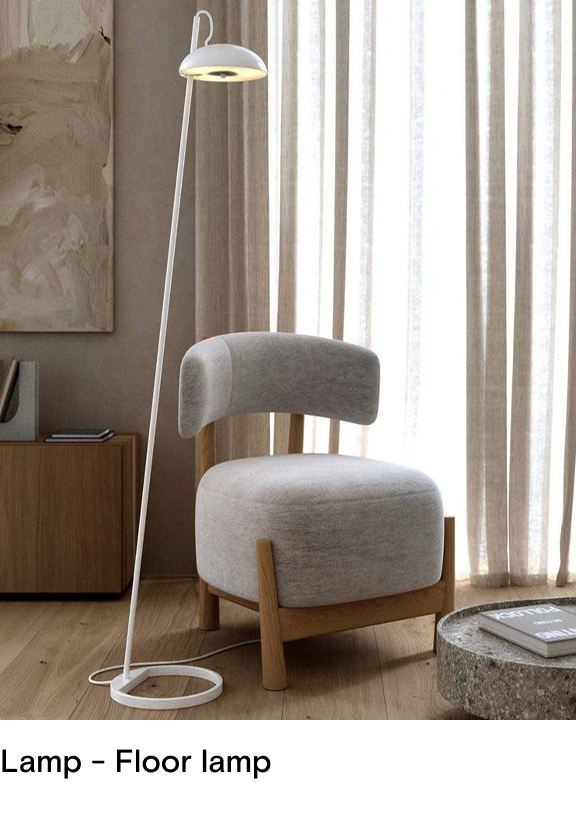
The initial release
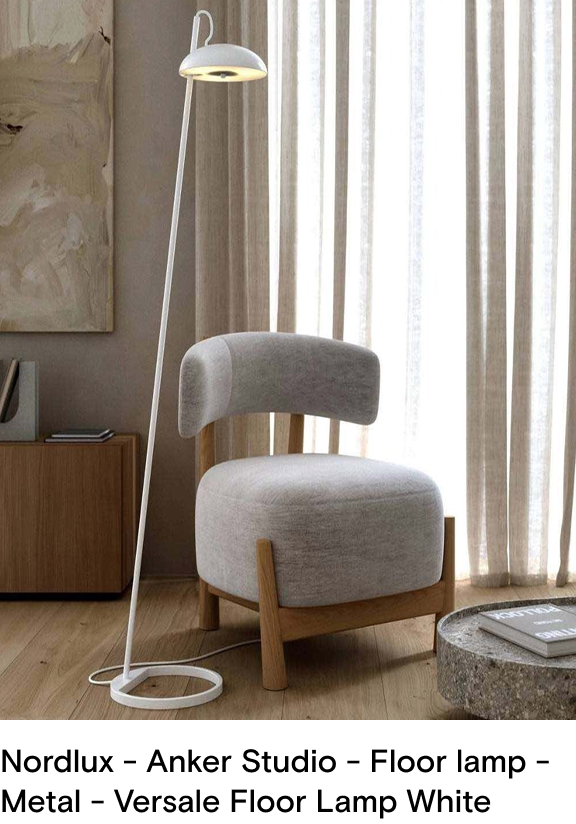
After fixing the title templates
All metrics recovered, and the Customer Effort Score for pro sellers climbed to around 70% once the fix landed.
Outcome & Impact
Results and metrics
- Full rollout and growth: OBS reached 100% of sellers, with the original category-based flow now fully deprecated. Weekly submissions grew from roughly 80,000 objects at rollout to 100,000, then 130,000, as the new flow made experts' work considerably faster, curating objects, organising auctions, and later organising collections.
- Stable core metrics: submission rate, approval rate, and sell rate all held on par with the old flow throughout the rollout.
- Gains for new sellers: CES, submission rate, and approval rate all improved for sellers submitting for the first time.
- Pro seller CES: climbed to around 70%.
- Better data, better buyer experience: richer, object-tied data translated directly into a better experience for buyers too, sharper search, more accurate filters, and stronger recommendations, built on roughly 3,500 object types instead of a fixed set of categories.
Leadership impact
- Bringing experts into user testing: personally drove the inclusion of Catawiki's internal experts in the testing process, strengthening the working relationship between tech and commercial and contributing to the formation of a new Commercial Operations team.
- A cross-functional template: established a way of working that other teams in the Supply vertical could reuse for projects affecting expert workflows.
- Foundations for what came next: laid the groundwork for price prediction, AI-assisted submission with image recognition, and a seamless desktop-to-mobile handover.
Reflection
What I'm most proud of is the scale of what this flow serves: around 200,000 sellers, across vastly different levels of tech-savviness, and an enormous diversity of object types. Submitting a car, a Rolex, a limited-edition Lego set, a designer armchair, the experience is the same. What changes is the questions asked and the photos requested, not the UI itself. Getting that balance right, across three years and a complete infrastructure overhaul, is the thing I'd point to first.
Two things I'd do differently: involve internal experts much earlier, and push for working prototypes sooner across the board. Experts struggled to engage with static mockups, but the moment we put working prototypes in front of them the feedback was immediate and rich.